
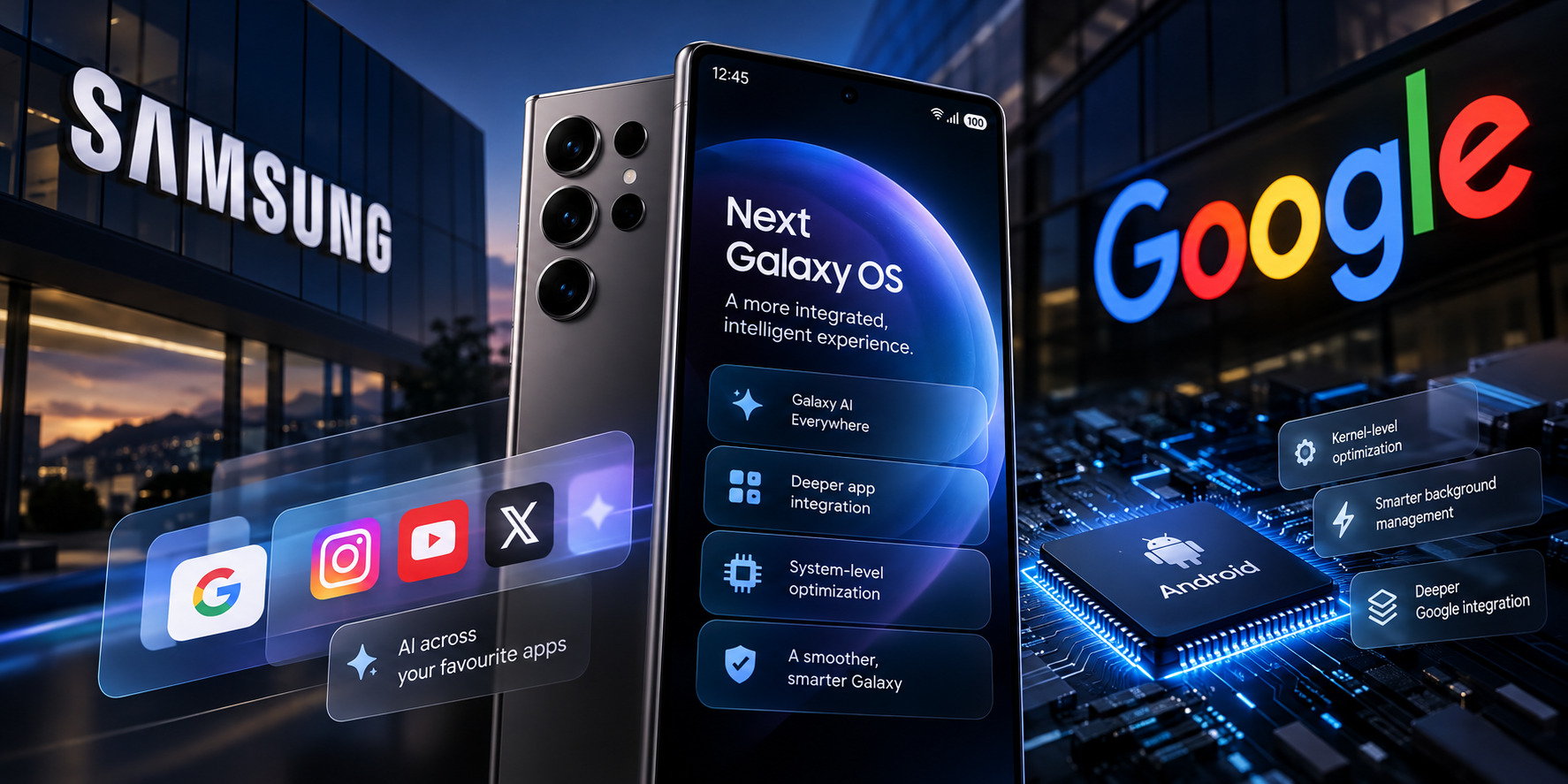
Samsung and Google Reportedly Working Toward a New Generation of Galaxy Software
A major software transition may be taking shape inside Samsung, with deeper Google collaboration, Android-level optimization, integrated AI and a fundamentally different approach to the Galaxy experience.
According to new information shared with Schrödinger's Leaks, Samsung is exploring a significant change in how its next-generation Galaxy software is developed.
Rather than continuing to build primarily around an increasingly feature-heavy Android interface, the company is reportedly pursuing a more integrated software direction, with Google playing a much larger role in development.
The project is described as a next-generation Galaxy operating system experience, although its eventual branding remains uncertain.
It could continue under the One UI name, receive a new versioning structure or introduce a different identity altogether.
What matters more than the name is the underlying development strategy.
1. A deeper Samsung–Google development partnership
Our information suggests that Samsung and Google are working toward closer software integration than the traditional relationship between Android's platform developer and a smartphone manufacturer.
The reported direction includes earlier access to certain Android application and platform developments, alongside closer coordination on software optimization.
This should not be interpreted as confirmation that Samsung will receive exclusive access to all Android applications or features before competing manufacturers.
Rather, the information points toward Samsung becoming more closely involved in the development and optimization process for Galaxy-specific implementations.
The objective is reportedly to reduce the separation between Android's underlying capabilities and Samsung's software layer.
2. Optimization closer to the Android kernel
One of the more technically significant elements concerns system-level optimization.
We're told the next-generation software direction involves closer cooperation on kernel-level performance and resource management.
This could affect how Galaxy devices coordinate processor workloads, memory usage, scheduling and background execution.
The potential significance is substantial.
Modern smartphones depend on coordination between the operating system, processor firmware, hardware drivers, memory management and application frameworks.
When those components are optimized together, improvements can extend beyond benchmark performance into responsiveness, energy consumption, multitasking and sustained workloads.
However, the exact implementation remains unclear.
We cannot yet establish whether this involves new Galaxy-specific kernel changes, shared Android platform development, scheduler tuning or a combination of several approaches.
3. A rethink of background tasks and cache management
Another area reportedly being examined is how Galaxy software handles background activity and cached resources.
The information suggests Samsung wants to reduce unnecessary background execution and improve the way system resources are retained, reused and released.
This is particularly relevant to applications that continue performing work after users leave them.
Rather than allowing unnecessary processes to consume resources indefinitely, the proposed direction appears to emphasize more deliberate background execution and improved resource allocation.
There is an important technical distinction here.
This does not mean Android will eliminate all background tasks or clear every cache.
Background services remain essential for notifications, synchronization, accessibility and other system functions. Caching is also fundamental to application performance.
The reported change concerns how these mechanisms may be managed, not their wholesale removal.
4. AI integrated directly into popular applications
Samsung is also reportedly pursuing much deeper AI integration with popular third-party applications, including social media platforms.
Instead of treating Galaxy AI as a collection of separate features that users must launch individually, the objective appears to be making intelligent capabilities available within everyday application workflows.
Potential use cases could include more context-aware assistance, media handling, content creation and actions spanning multiple applications.
These examples illustrate the possible direction rather than a confirmed feature list.
We have not independently established which social media companies are participating or whether any specific application integrations have received final approval.
The larger idea is to make AI feel like part of the operating system rather than an additional layer sitting above it.
5. Moving beyond the feature-heavy One UI philosophy
Perhaps the most interesting aspect of this information is the reported change in Samsung's software priorities.
For years, One UI has differentiated Galaxy devices through extensive customization, multitasking capabilities, productivity features and Samsung-specific services.
That strategy has given Samsung considerable flexibility, but the next stage may place greater emphasis on integration and optimization.
The reported direction does not necessarily mean removing the features that make Galaxy software distinctive.
Instead, it suggests Samsung wants the software experience to feel more unified, with fewer disconnected systems and stronger coordination between Android, Galaxy services, hardware and third-party applications.
A feature should not simply exist because Samsung can implement it. It should work naturally with the rest of the device.
That appears to be the philosophy under consideration.
6. Is Samsung replacing One UI?
There is no confirmation of that.
Our information refers to a next-generation Galaxy software direction, not a finalized consumer product name.
Samsung could retain One UI while substantially changing its underlying architecture and development model.
A completely new name is also possible, but we have no reliable basis to announce one.
Likewise, we cannot currently confirm the first Galaxy device, Android version or release window associated with this work.
What is already established?
Samsung and Google have an existing history of software collaboration, including Gemini integration, Android intelligence features and application automation.
Google has publicly outlined plans to make Android more capable of performing actions across applications, while Samsung has already introduced several of those capabilities on Galaxy devices.
Our new information goes further, suggesting that the collaboration could extend more deeply into Galaxy software development, performance optimization and the operating system's overall direction.
Those additional details remain unannounced and subject to change.
The bigger picture
If this development direction reaches commercial Galaxy devices, Samsung's next major software improvement may not be another long list of visible features.
It could be a more fundamental change in how the entire experience works.
A Galaxy device where Android, Samsung services, AI, third-party applications and hardware are developed with closer coordination.
For now, the project remains an emerging development report rather than a confirmed product announcement.
We'll continue following its progress, including the software architecture, naming, supported devices and the extent of Google's involvement.
Schrödinger's Leaks | Exclusive Reporting